Mind Mappings: Enabling Efficient Algorithm-Accelerator Mapping Space Search
Scope
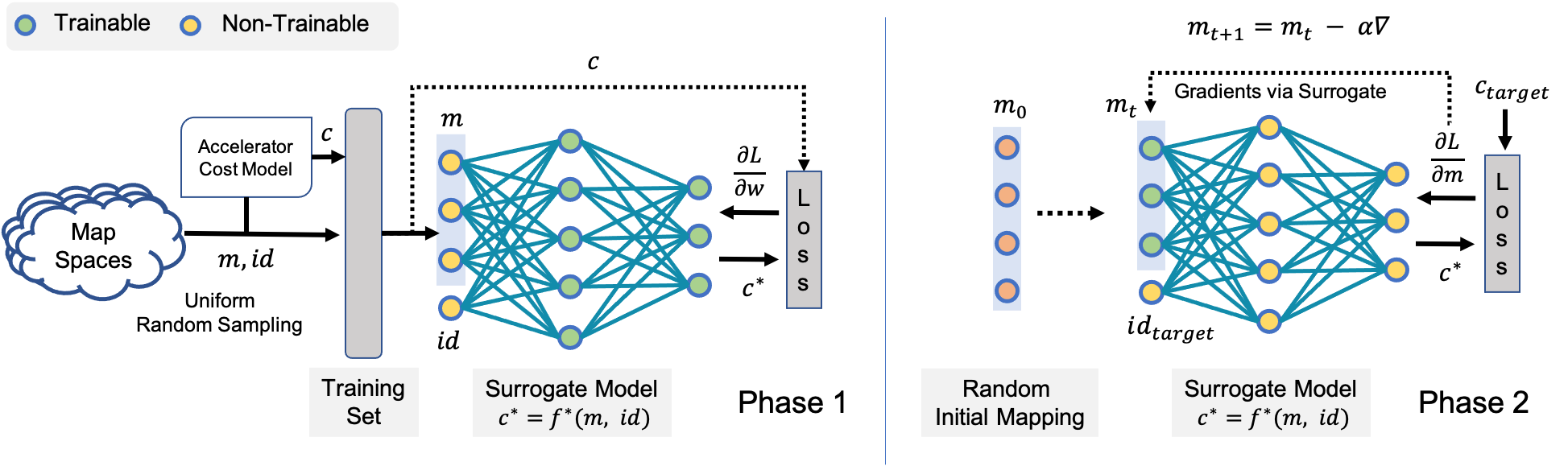
Programmable accelerators admit an enormous number of ways to place and schedule a workload. This work turns that discrete search problem into one that can be approached with gradient-based optimization.
Abstract
The efficiency of specialized hardware depends heavily on the mapping from an algorithm to the architecture. These mapping spaces are large, non-smooth, and non-convex, so prior methods rely on expert choices or general-purpose heuristics. Mind Mappings constructs a smooth, differentiable approximation of the original search space and uses gradients to find high-quality mappings. Across convolutional neural networks and tensor decomposition workloads, it finds more efficient mappings than simulated annealing, genetic algorithms, and reinforcement learning under equal search budgets.